---
title: "One factory, NOW eight partners - See it live at #ICCUnleashed"
description: Three new partners, a palletizer on an Allen-Bradley PLC, and secure remote access to your legacy PLCs on demand.
image: https://blog.opto22.com/hubfs/ICC2026AcmeBlog1.png
---
- [Log in](https://www.opto22.com/logon?returnurl=%2f)
- [Register](https://www.opto22.com/Special-Pages/Logon.aspx)
- [Your Cart](https://www.opto22.com/Checkout/Shopping-Cart)
- [Contact Us](https://www.opto22.com/support/contact-us)
[](https://www.opto22.com)
- [Products](https://www.opto22.com/products)
- [What Do You Want to Do?](https://www.opto22.com/products/what-do-you-want-to-do)
- [groov RIO](https://www.opto22.com/products/groov-rio)
- [groov EPIC System](https://www.opto22.com/products/groov-epic-system)
- [Case Studies](https://www.opto22.com/products/groov-case-studies)
- [Product Selector](https://www.opto22.com/products/product-selector)
- [Product Families](https://www.opto22.com/products/product-families)
- [IIoT System Architecture](https://www.opto22.com/support/resources-tools/demos/groov-epic-groov-rio-architecture)
- [MQTT Resources](https://www.opto22.com/products/mqtt-resources)
- [Cybersecurity](https://www.opto22.com/products/cybersecurity)
- [Power and Energy Monitoring](https://www.opto22.com/products/power-and-energy-monitoring)
- [How to Buy](https://www.opto22.com/products/how-to-buy)
- [Hands-On Learning and Demo Units](https://www.opto22.com/products/hands-on-learning-and-demo-units)
- [Product Comparisons and Compatibility](https://www.opto22.com/products/product-comparisons-and-compatibility)
- [System Configurator](https://www.opto22.com/products/system-configurator)
- [Support](https://www.opto22.com/support)
- [Manage groov](https://www.opto22.com/logon?returnurl=%2fmy-opto%2fmanage-groov)
- [Documents](https://www.opto22.com/Support/Resources-Tools?rt=59)
- [Downloads](https://www.opto22.com/Support/Resources-Tools?rt=68)
- [Videos](https://www.opto22.com/Support/Videos)
- [KnowledgeBase](https://www.opto22.com/Support/Resources-Tools?rt=67)
- [Training](https://www.opto22.com/support/training-options)
- [Troubleshooting](https://www.opto22.com/support/troubleshooting)
- [Image Library](https://www.opto22.com/support/resources-tools/image-library-svg-editors)
- [Developers](https://developer.opto22.com/)
- [Talk to an Engineer](https://www.opto22.com/support/talk-to-an-engineer)
- [Contact Us](https://www.opto22.com/support/contact-us)
- [Warranties](https://www.opto22.com/support/warranties)
- [Agency Approvals/Compliance](https://www.opto22.com/support/agency-approvals)
- [Privacy Policy](https://www.opto22.com/support/privacy)
- [About Us](https://www.opto22.com/about-us)
- [History](https://www.opto22.com/about-us/history)
- [Location](https://www.opto22.com/about-us/directions)
- [Corporate Contacts](https://www.opto22.com/about-us/corporate-contacts)
- [Opto 22 Product Philosophy](https://www.opto22.com/about-us/opto-22-product-philosophy)
- [Customer Quotes/Testimonials](https://www.opto22.com/about-us/customer-quotes-testimonials)
- [Virtual Tour](https://www.opto22.com/about-us/virtual-tour)
- [Pressroom](https://www.opto22.com/about-us/pressroom)
- [Distributors](https://www.opto22.com/about-us/distributors)
- [International](https://www.opto22.com/about-us/international)
- [Sustainability](https://www.opto22.com/about-us/sustainability)
- [Careers](https://www.opto22.com/about-us/careers)
- [Community](https://www.opto22.com/community)
- [OptoPartners](https://www.opto22.com/community/opto-partners)
- [Technology Partners](https://www.opto22.com/community/technology-partners)
- [Education Partnerships](https://info.opto22.com/partnering-in-education)
- [Opto Blog](https://blog.opto22.com/)
- [Opto Forums](http://forums.opto22.com/)
- [Events](https://www.opto22.com/community/events)
- [Articles](https://www.opto22.com/articles)
- [Log In](https://www.opto22.com/logon)
- [Register](https://www.opto22.com/Special-Pages/Logon.aspx)
- [Your Cart](https://www.opto22.com/Checkout/Shopping-Cart)
- [Contact Us](https://www.opto22.com/support/contact-us)
- [Products](https://www.opto22.com/products)
- [What Do You Want to Do?](https://www.opto22.com/products/what-do-you-want-to-do)
- [groov RIO](https://www.opto22.com/products/groov-rio)
- [groov EPIC System](https://www.opto22.com/products/groov-epic-system)
- [Case Studies](https://www.opto22.com/products/groov-case-studies)
- [Product Selector](https://www.opto22.com/products/product-selector)
- [Product Families](https://www.opto22.com/products/product-families)
- [IIoT System Architecture](https://www.opto22.com/support/resources-tools/demos/groov-epic-groov-rio-architecture)
- [MQTT Resources](https://www.opto22.com/products/mqtt-resources)
- [Cybersecurity](https://www.opto22.com/products/cybersecurity)
- [Power and Energy Monitoring](https://www.opto22.com/products/power-and-energy-monitoring)
- [How to Buy](https://www.opto22.com/products/how-to-buy)
- [Hands-On Learning and Demo Units](https://www.opto22.com/products/hands-on-learning-and-demo-units)
- [Product Comparisons and Compatibility](https://www.opto22.com/products/product-comparisons-and-compatibility)
- [System Configurator](https://www.opto22.com/products/system-configurator)
- [Support](https://www.opto22.com/support)
- [Manage groov](https://www.opto22.com/logon?returnurl=%2fmy-opto%2fmanage-groov)
- [Documents](https://www.opto22.com/Support/Resources-Tools?rt=59)
- [Downloads](https://www.opto22.com/Support/Resources-Tools?rt=68)
- [Videos](https://www.opto22.com/Support/Videos)
- [KnowledgeBase](https://www.opto22.com/Support/Resources-Tools?rt=67)
- [Training](https://www.opto22.com/support/training-options)
- [Troubleshooting](https://www.opto22.com/support/troubleshooting)
- [Image Library](https://www.opto22.com/support/resources-tools/image-library-svg-editors)
- [Developers](https://developer.opto22.com/)
- [Talk to an Engineer](https://www.opto22.com/support/talk-to-an-engineer)
- [Contact Us](https://www.opto22.com/support/contact-us)
- [Warranties](https://www.opto22.com/support/warranties)
- [Agency Approvals/Compliance](https://www.opto22.com/support/agency-approvals)
- [Privacy Policy](https://www.opto22.com/support/privacy)
- [About Us](https://www.opto22.com/about-us)
- [History](https://www.opto22.com/about-us/history)
- [Location](https://www.opto22.com/about-us/directions)
- [Corporate Contacts](https://www.opto22.com/about-us/corporate-contacts)
- [Opto 22 Product Philosophy](https://www.opto22.com/about-us/opto-22-product-philosophy)
- [Customer Quotes/Testimonials](https://www.opto22.com/about-us/customer-quotes-testimonials)
- [Virtual Tour](https://www.opto22.com/about-us/virtual-tour)
- [Pressroom](https://www.opto22.com/about-us/pressroom)
- [Distributors](https://www.opto22.com/about-us/distributors)
- [International](https://www.opto22.com/about-us/international)
- [Sustainability](https://www.opto22.com/about-us/sustainability)
- [Careers](https://www.opto22.com/about-us/careers)
- [Community](https://www.opto22.com/community)
- [OptoPartners](https://www.opto22.com/community/opto-partners)
- [Technology Partners](https://www.opto22.com/community/technology-partners)
- [Education Partnerships](https://info.opto22.com/partnering-in-education)
- [Opto Blog](https://blog.opto22.com/)
- [Opto Forums](http://forums.opto22.com/)
- [Events](https://www.opto22.com/community/events)
- [Articles](https://www.opto22.com/articles)
- [Log In](https://www.opto22.com/logon)
- [Register](https://www.opto22.com/Special-Pages/Logon.aspx)
- [Your Cart](https://www.opto22.com/Checkout/Shopping-Cart)
- [Contact Us](https://www.opto22.com/support/contact-us)
# One factory, NOW eight partners - See it live at #ICCUnleashed
# OptoBlog
# One factory, NOW eight partners - See it live at #ICCUnleashed
Posted by [Dan White](https://blog.opto22.com/optoblog/author/dan-white) on Sep 18, 2026, 7:30:00 AM
- [Tweet](https://twitter.com/share)
### Three new partners, a palletizer on an Allen-Bradley PLC, and secure remote access to your legacy PLCs on demand.
If you're heading to the Ignition Community Conference next week, block out Wednesday morning at 9:00 a.m. The ACME Dynamite factory we brought to Automate has grown since May, and ICC is your chance to see it live.
**Quick refresher:** ACME is a fictional dynamite plant built by real automation companies to answer a practical question: what happens when you pick the best tool for each layer instead of buying one vendor's whole stack?
Two lines batch and discharge product following ISA-88. Line 1 runs a well-tuned loop, Line 2 is deliberately untuned, and the trends show you what good tuning is worth. Everything on the screen is live. Go look: [op22.co/acme](https://acme.labs.factorystack.io/data/perspective/client/ACMECloudDemo/).
[Since our earlier post](https://blog.opto22.com/optoblog/one-factory-five-partners-zero-compromises), we've added three partners and three new pieces of plant. You'll want to check it out.
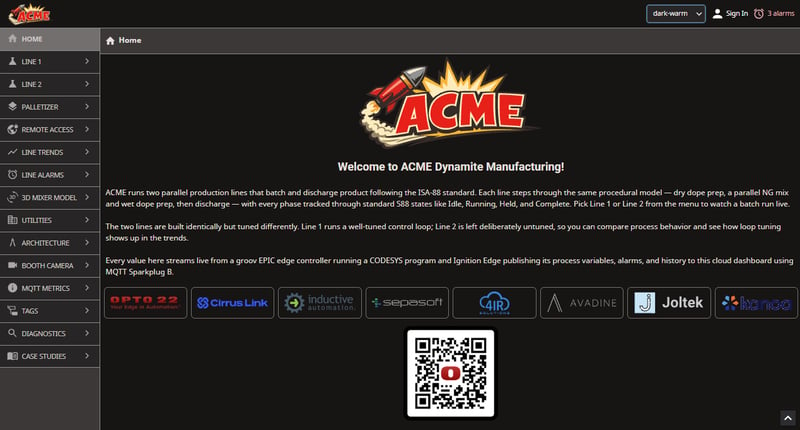
##### A palletizer running on an Allen-Bradley PLC
The new palletizer cell runs on a CompactLogix 5380. Vlad Romanov, with Joltek, built the application, and we left the PLC right where a real plant would leave it, in charge of the machine.
A *groov* RIO running Ignition Edge pulls data off that PLC over OPC UA and publishes MQTT Sparkplug data to the broker using Cirrus Link’s MQTT Transmission module. Open the [Palletizer page](https://acme.labs.factorystack.io/data/perspective/client/ACMECloudDemo/palletizer), and you'll see cases at the infeed, cumulative case count, cases per hour over the trailing 60 minutes, three staging slots filling as cases arrive, the servo hoist stepping through its layers, and the number of empty pallets left in the magazine. The PLC program didn't change.
That's the brownfield story on one screen. Your controls keep the machine running, and the data still gets where it needs to go.
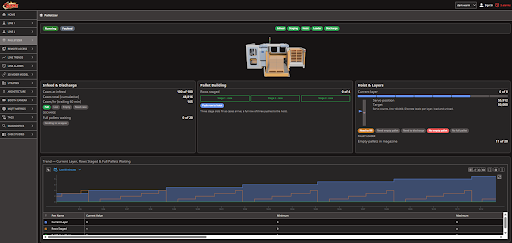
##### Remote access, one port at a time
Every plant has this problem: a machine builder needs access to their equipment to troubleshoot, and your choices are a standing VPN into your network or a costly service call.
But the all-new [Remote Access page](https://acme.labs.factorystack.io/data/perspective/client/ACMECloudDemo/remote-access) shows another way. The *groov* RIO in the new palletizer cell runs an OpenVPN client, and each path to the PLC rides that one tunnel as its own conduit: EtherNet/IP on 44818 for Studio 5000, OPC UA on 4840, and the controller's web page on 8080.
You open a conduit when someone needs it and close it when they're done, one at a time. While a conduit is closed, nothing on that port is reachable. Engineering, the machine vendor, and Joltek each get only the conduit they need, and you can watch them turn green and red on the page.
The screen doing that work in Ignition uses [Avadine's Opto 22 Integration Module](https://inductiveautomation.com/moduleshowcase/module/avadine-opto22-integration). It controls the RIO's OpenVPN connection and port redirects via the *groov* APIs, so whoever grants access does so from Ignition rather than logging into the device.
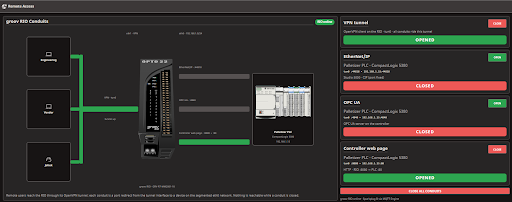
##### Adding new assets that nobody was watching
We put our building HVAC units on the demo, too. Real units, on the first floor of Opto 22 headquarters in Temecula, California. A *groov* RIO instruments them and publishes its data over MQTT to a *groov* EPIC.
Check out the Utilities pages, where that equipment is ours too: building power, two air compressors, air dryer dew point, utility room conditions, and a live camera pointed at the assets in the room.
None of it is simulated. When you watch a compressor cycle on that screen, a compressor in Temecula is cycling. We run our own plant on what we're showing you.
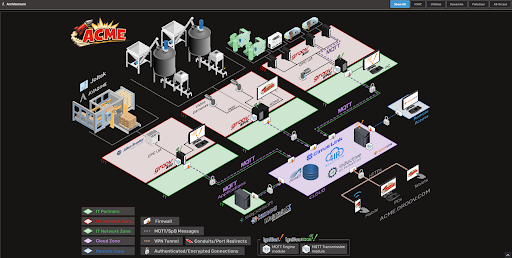
The [Architecture page](https://acme.labs.factorystack.io/data/perspective/client/ACMECloudDemo/arch) follows the same idea. Filter by HVAC, Utilities, Dynamite, Palletizer, or the Allen-Bradley access path, and you trace just that one system from field device to cloud.
##### Who does what
The demo works because eight companies each brought the thing they're best at, and because they all agree on open standards.
- [**Opto 22**](https://www.opto22.com/) runs the process. [*groov* EPIC](https://www.opto22.com/products/groov-epic-system) executes the ISA-88 batch in CODESYS on both lines, and *groov* EPIC and [*groov* RIO](https://www.opto22.com/products/groov-rio) connect what's already in the plant over OPC UA, Modbus TCP, and EtherNet/IP, then publish it with MQTT Sparkplug. The RIO also carries secure remote access.
- [**Cirrus Link**](https://cirrus-link.com/) moves the data. Chariot is the MQTT broker; MQTT Transmission publishes tags from edge devices, and MQTT Engine subscribes to them and delivers them to Ignition. It's all Sparkplug, so values are published on change, and whoever needs them subscribes.
- [**Inductive Automation**](https://inductiveautomation.com/) ties it together. Ignition is the SCADA and development platform: visualization, alarms, and history, with Ignition Edge out at the machines.
- [**Sepasoft**](https://www.sepasoft.com/) adds MES on top of Ignition. Their Batch Procedure module handles the ISA-88 recipes and batch records, SepaIQ analyzes how each batch actually ran, and ISA-95 connects the plant floor to the business systems.
- [**4IR Solutions**](https://4ir.cloud/) runs the cloud. Hosting, databases, backups, security, and secure connectivity on their FactoryStack platform.
- [**Joltek**](https://www.joltek.com/) brought the palletizer, along with the plant-side perspective of an independent integrator.
- [**Avadine**](https://avadine.com/) wrote the [third-party Ignition module](https://inductiveautomation.com/moduleshowcase/module/avadine-opto22-integration) that controls the OpenVPN connection and port redirects on *groov* devices, turning remote access into something you can manage securely from Ignition.
- [**Kanoa**](https://kanoa.ai/) brings a full CMMS: work order generation, spare parts inventory, and the whole maintenance side of the house. Work orders are generated from live machine data rather than a calendar, and an operator can request maintenance directly from their screen. They're showing condition-based monitoring at their booth at ICC.
Nobody owns the whole stack. Swap a layer or scale a layer, and the rest keeps running.
##### Close the Gaps, Wednesday, September 23, at 9:00 a.m.
Opto 22’s Benson Hougland and Garrick Reichert present "Close the Gaps: Connect any asset to Ignition with Opto 22's *groov* EPIC & RIO" on Wednesday, September 23, from 9:00 to 9:45 a.m. in the Gateway Theater.
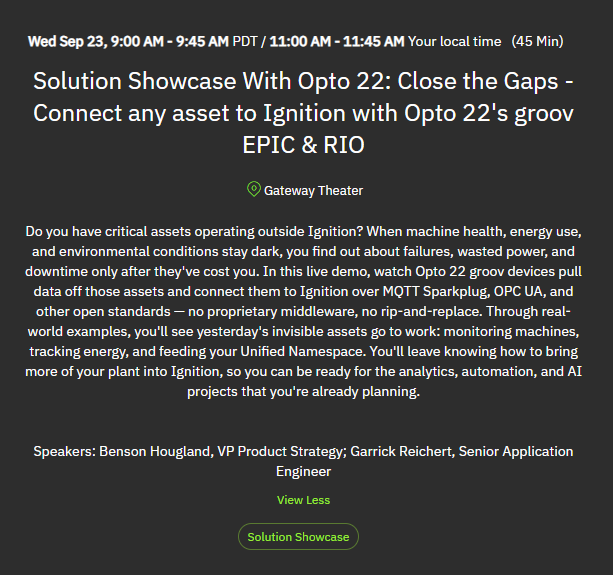
ICC runs from September 22 to 24 at the SAFE Credit Union Convention Center in Sacramento. If you aren’t registered, [get your tickets now](https://icc.inductiveautomation.com/register)!
##### Or see it before you get there
Open the demo at [op22.co/acme](https://acme.labs.factorystack.io/data/perspective/client/ACMECloudDemo/), then find us at ICC, and we'll walk you through the rest.
Can't make it to Sacramento? [Talk to an Opto 22 engineer](https://www.opto22.com/support/talk-to-an-engineer), and we'll start from where you are.
Topics: [Ignition Edge](https://blog.opto22.com/optoblog/topic/ignition-edge), [Ignition](https://blog.opto22.com/optoblog/topic/ignition), [Ignition Community Conference](https://blog.opto22.com/optoblog/topic/ignition-community-conference), [Cirrus Link Solutions](https://blog.opto22.com/optoblog/topic/cirrus-link-solutions), [Technology Partners](https://blog.opto22.com/optoblog/topic/technology-partners), [Ignition Cloud Edition](https://blog.opto22.com/optoblog/topic/ignition-cloud-edition)
### Written by [Dan White](https://blog.opto22.com/optoblog/author/dan-white)
Dan has worked at Opto 22 for more than a decade. His Tufts Engineering background, MBA in International Business, and prior industrial controls experience give him a unique edge in automation. Dan enjoys staying active through biking, basketball, skiing – and keeping up with his three young kids!
Find me on:
[LinkedIn](https://www.linkedin.com/in/dan-white-opto22/)
### Subscribe to Email Updates
### Recent Posts
### Posts by Topic
- [groov EPIC (506)](https://blog.opto22.com/optoblog/topic/groov-epic)
- [groov RIO (301)](https://blog.opto22.com/optoblog/topic/groov-rio)
- [optonews (218)](https://blog.opto22.com/optoblog/topic/optonews)
- [IIoT (214)](https://blog.opto22.com/optoblog/topic/iiot)
- [groov (192)](https://blog.opto22.com/optoblog/topic/groov)
- [IoT (148)](https://blog.opto22.com/optoblog/topic/iot)
- [Ignition (131)](https://blog.opto22.com/optoblog/topic/ignition)
- [Internet of Things (131)](https://blog.opto22.com/optoblog/topic/internet-of-things)
- [Node-RED (129)](https://blog.opto22.com/optoblog/topic/node-red)
- [PACs (127)](https://blog.opto22.com/optoblog/topic/pacs)
- [MQTT (125)](https://blog.opto22.com/optoblog/topic/mqtt)
- [Events & conferences (117)](https://blog.opto22.com/optoblog/topic/events-conferences)
- [Case studies (110)](https://blog.opto22.com/optoblog/topic/case-studies)
- [Industrial Internet of Things (104)](https://blog.opto22.com/optoblog/topic/industrial-internet-of-things)
- [Videos (96)](https://blog.opto22.com/optoblog/topic/videos)
- [Updates (82)](https://blog.opto22.com/optoblog/topic/updates)
- [Tips (81)](https://blog.opto22.com/optoblog/topic/tips)
- [OptoPartner (76)](https://blog.opto22.com/optoblog/topic/optopartner)
- [Integrators (75)](https://blog.opto22.com/optoblog/topic/integrators)
- [Remote monitoring (75)](https://blog.opto22.com/optoblog/topic/remote-monitoring)
- [Ignition Edge (74)](https://blog.opto22.com/optoblog/topic/ignition-edge)
- [Webinars (70)](https://blog.opto22.com/optoblog/topic/webinars)
- [I/O (69)](https://blog.opto22.com/optoblog/topic/io)
- [Process control (69)](https://blog.opto22.com/optoblog/topic/process-control)
- [Energy management (64)](https://blog.opto22.com/optoblog/topic/energy-management)
- [CODESYS (62)](https://blog.opto22.com/optoblog/topic/codesys)
- [Training (57)](https://blog.opto22.com/optoblog/topic/training)
- [PAC Control (51)](https://blog.opto22.com/optoblog/topic/pac-control)
- [PAC Project (49)](https://blog.opto22.com/optoblog/topic/pac-project)
- [groov View (49)](https://blog.opto22.com/optoblog/topic/groov-view)
- [OEM (48)](https://blog.opto22.com/optoblog/topic/oem)
- [cybersecurity (48)](https://blog.opto22.com/optoblog/topic/cybersecurity)
- [digital transformation (46)](https://blog.opto22.com/optoblog/topic/digital-transformation)
- [Discrete control (45)](https://blog.opto22.com/optoblog/topic/discrete-control)
- [Machine builder (40)](https://blog.opto22.com/optoblog/topic/machine-builder)
- [Firmware (39)](https://blog.opto22.com/optoblog/topic/firmware)
- [edge computing (39)](https://blog.opto22.com/optoblog/topic/edge-computing)
- [EPIC (37)](https://blog.opto22.com/optoblog/topic/epic)
- [system integrator (37)](https://blog.opto22.com/optoblog/topic/system-integrator)
- [Inductive Automation (35)](https://blog.opto22.com/optoblog/topic/inductive-automation)
- [industrial automation (34)](https://blog.opto22.com/optoblog/topic/industrial-automation)
- [groov Manage (33)](https://blog.opto22.com/optoblog/topic/groov-manage)
- [Data acquisition (31)](https://blog.opto22.com/optoblog/topic/data-acquisition)
- [Ignition Community Conference (31)](https://blog.opto22.com/optoblog/topic/ignition-community-conference)
- [Security (30)](https://blog.opto22.com/optoblog/topic/security)
- [Sparkplug (30)](https://blog.opto22.com/optoblog/topic/sparkplug)
- [Factory Training (29)](https://blog.opto22.com/optoblog/topic/factory-training)
- [Networking (28)](https://blog.opto22.com/optoblog/topic/networking)
- [snap pac (28)](https://blog.opto22.com/optoblog/topic/snap-pac)
- [REST API (26)](https://blog.opto22.com/optoblog/topic/rest-api)
- [New products (25)](https://blog.opto22.com/optoblog/topic/new-products)
- [Technology Partners (24)](https://blog.opto22.com/optoblog/topic/technology-partners)
- [Water & wastewater (23)](https://blog.opto22.com/optoblog/topic/water-amp-wastewater)
- [PLCs (21)](https://blog.opto22.com/optoblog/topic/plcs)
- [manufacturing (21)](https://blog.opto22.com/optoblog/topic/manufacturing)
- [API (20)](https://blog.opto22.com/optoblog/topic/api)
- [Cirrus Link Solutions (20)](https://blog.opto22.com/optoblog/topic/cirrus-link-solutions)
- [developer (20)](https://blog.opto22.com/optoblog/topic/developer)
- [groov EPIC Learning Center (20)](https://blog.opto22.com/optoblog/topic/groov-epic-learning-center)
- [OptoU (19)](https://blog.opto22.com/optoblog/topic/optou)
- [smart manufacturing (19)](https://blog.opto22.com/optoblog/topic/smart-manufacturing)
- [Electronics (18)](https://blog.opto22.com/optoblog/topic/electronics)
- [HMI (18)](https://blog.opto22.com/optoblog/topic/hmi)
- [OPC UA (18)](https://blog.opto22.com/optoblog/topic/opc-ua)
- [Oil & gas (18)](https://blog.opto22.com/optoblog/topic/oil-gas)
- [groov rio emu (18)](https://blog.opto22.com/optoblog/topic/groov-rio-emu)
- [Food & beverage (17)](https://blog.opto22.com/optoblog/topic/food-amp-beverage)
- [OptoPartner video (17)](https://blog.opto22.com/optoblog/topic/optopartner-video)
- [energy monitoring (17)](https://blog.opto22.com/optoblog/topic/energy-monitoring)
- [podcast (17)](https://blog.opto22.com/optoblog/topic/podcast)
- [Building management (16)](https://blog.opto22.com/optoblog/topic/building-management)
- [Awards and recognition (15)](https://blog.opto22.com/optoblog/topic/awards-and-recognition)
- [REST (15)](https://blog.opto22.com/optoblog/topic/rest)
- [SCADA (15)](https://blog.opto22.com/optoblog/topic/scada)
- [mobile (15)](https://blog.opto22.com/optoblog/topic/mobile)
- [Migration (14)](https://blog.opto22.com/optoblog/topic/migration)
- [OptoChannel (13)](https://blog.opto22.com/optoblog/topic/optochannel)
- [EPIC Security (12)](https://blog.opto22.com/optoblog/topic/epic-security)
- [Opto 22 product support (12)](https://blog.opto22.com/optoblog/topic/opto-22-product-support)
- [groov Manage series (12)](https://blog.opto22.com/optoblog/topic/groov-manage-series)
- [I/O modules (11)](https://blog.opto22.com/optoblog/topic/i-o-modules)
- [Modbus (11)](https://blog.opto22.com/optoblog/topic/modbus)
- [OptoForum (11)](https://blog.opto22.com/optoblog/topic/optoforum)
- [PAC Manager (11)](https://blog.opto22.com/optoblog/topic/pac-manager)
- [power monitoring (11)](https://blog.opto22.com/optoblog/topic/power-monitoring)
- [PAC Display (10)](https://blog.opto22.com/optoblog/topic/pac-display)
- [oil and gas (10)](https://blog.opto22.com/optoblog/topic/oil-and-gas)
- [Art of the Possible (9)](https://blog.opto22.com/optoblog/topic/art-of-the-possible)
- [Deepsea Challenge (9)](https://blog.opto22.com/optoblog/topic/deepsea-challenge)
- [IntegrateLive! (9)](https://blog.opto22.com/optoblog/topic/integratelive)
- [OT data (9)](https://blog.opto22.com/optoblog/topic/ot-data)
- [PID loop control (9)](https://blog.opto22.com/optoblog/topic/pid-loop-control)
- [RESTful server (9)](https://blog.opto22.com/optoblog/topic/restful-server)
- [Raspberry Pi (9)](https://blog.opto22.com/optoblog/topic/raspberry-pi)
- [holiday schedule (9)](https://blog.opto22.com/optoblog/topic/holiday-schedule)
- [white paper (9)](https://blog.opto22.com/optoblog/topic/white-paper)
- [Automation World (8)](https://blog.opto22.com/optoblog/topic/automation-world)
- [Edge I/O (8)](https://blog.opto22.com/optoblog/topic/edge-i-o)
- [I/O (8)](https://blog.opto22.com/optoblog/topic/i-o)
- [SSRs (8)](https://blog.opto22.com/optoblog/topic/ssrs)
- [Unified Namespace (8)](https://blog.opto22.com/optoblog/topic/unified-namespace)
- [data visualization (8)](https://blog.opto22.com/optoblog/topic/data-visualization)
- [holiday hours (8)](https://blog.opto22.com/optoblog/topic/holiday-hours)
- [webinar (8)](https://blog.opto22.com/optoblog/topic/webinar)
- [IEC 61131-3 (7)](https://blog.opto22.com/optoblog/topic/iec-61131-3)
- [Ignition Cloud Edition (7)](https://blog.opto22.com/optoblog/topic/ignition-cloud-edition)
- [MQTT implementation (7)](https://blog.opto22.com/optoblog/topic/mqtt-implementation)
- [Who's groovin (7)](https://blog.opto22.com/optoblog/topic/whos-groovin)
- [groov server for windows (7)](https://blog.opto22.com/optoblog/topic/groov-server-for-windows)
- [secure shell (7)](https://blog.opto22.com/optoblog/topic/secure-shell)
- [technical tips (7)](https://blog.opto22.com/optoblog/topic/technical-tips)
- [ARC Forum (6)](https://blog.opto22.com/optoblog/topic/arc-forum)
- [Careers (6)](https://blog.opto22.com/optoblog/topic/careers)
- [EPIC Security Series (6)](https://blog.opto22.com/optoblog/topic/epic-security-series)
- [Eclipse Foundation (6)](https://blog.opto22.com/optoblog/topic/eclipse-foundation)
- [Ignition Community Live (6)](https://blog.opto22.com/optoblog/topic/ignition-community-live)
- [Linux (6)](https://blog.opto22.com/optoblog/topic/linux)
- [data center (6)](https://blog.opto22.com/optoblog/topic/data-center)
- [interactive demo (6)](https://blog.opto22.com/optoblog/topic/interactive-demo)
- [machine monitoring (6)](https://blog.opto22.com/optoblog/topic/machine-monitoring)
- [open source (6)](https://blog.opto22.com/optoblog/topic/open-source)
- [ssh (6)](https://blog.opto22.com/optoblog/topic/ssh)
- [Anniversary (5)](https://blog.opto22.com/optoblog/topic/anniversary)
- [Digital I/O for Raspberry Pi (5)](https://blog.opto22.com/optoblog/topic/digital-i-o-for-raspberry-pi)
- [IIoT System Architecture (5)](https://blog.opto22.com/optoblog/topic/iiot-system-architecture)
- [OptoNews 2015-12-02 (5)](https://blog.opto22.com/optoblog/topic/optonews-2015-12-02)
- [OptoOPCServer (5)](https://blog.opto22.com/optoblog/topic/optoopcserver)
- [SVG (5)](https://blog.opto22.com/optoblog/topic/svg)
- [certificate (5)](https://blog.opto22.com/optoblog/topic/certificate)
- [cloud computing (5)](https://blog.opto22.com/optoblog/topic/cloud-computing)
- [product philosophy (5)](https://blog.opto22.com/optoblog/topic/product-philosophy)
- [software (5)](https://blog.opto22.com/optoblog/topic/software)
- [system integration (5)](https://blog.opto22.com/optoblog/topic/system-integration)
- [CODESYS blog series (4)](https://blog.opto22.com/optoblog/topic/codesys-blog-series)
- [COVID-19 Update (4)](https://blog.opto22.com/optoblog/topic/covid-19-update)
- [EdgeX (4)](https://blog.opto22.com/optoblog/topic/edgex)
- [HiveMQ (4)](https://blog.opto22.com/optoblog/topic/hivemq)
- [OpenVPN (4)](https://blog.opto22.com/optoblog/topic/openvpn)
- [OptoDataLink (4)](https://blog.opto22.com/optoblog/topic/optodatalink)
- [OptoNews 2015-03-04 (4)](https://blog.opto22.com/optoblog/topic/optonews-2015-03-04)
- [OptoNews 2015-03-18 (4)](https://blog.opto22.com/optoblog/topic/optonews-2015-03-18)
- [OptoNews 2015-04-01 (4)](https://blog.opto22.com/optoblog/topic/optonews-2015-04-01)
- [OptoNews 2015-04-15 (4)](https://blog.opto22.com/optoblog/topic/optonews-2015-04-15)
- [OptoNews 2015-04-29 (4)](https://blog.opto22.com/optoblog/topic/optonews-2015-04-29)
- [OptoNews 2015-05-21 (4)](https://blog.opto22.com/optoblog/topic/optonews-2015-05-21)
- [OptoNews 2015-06-03 (4)](https://blog.opto22.com/optoblog/topic/optonews-2015-06-03)
- [OptoNews 2015-06-17 (4)](https://blog.opto22.com/optoblog/topic/optonews-2015-06-17)
- [OptoNews 2015-07-01 (4)](https://blog.opto22.com/optoblog/topic/optonews-2015-07-01)
- [OptoNews 2015-07-15 (4)](https://blog.opto22.com/optoblog/topic/optonews-2015-07-15)
- [OptoNews 2015-07-29 (4)](https://blog.opto22.com/optoblog/topic/optonews-2015-07-29)
- [OptoNews 2015-08-12 (4)](https://blog.opto22.com/optoblog/topic/optonews-2015-08-12)
- [OptoNews 2015-08-26 (4)](https://blog.opto22.com/optoblog/topic/optonews-2015-08-26)
- [OptoNews 2015-09-09 (4)](https://blog.opto22.com/optoblog/topic/optonews-2015-09-09)
- [OptoNews 2015-09-23 (4)](https://blog.opto22.com/optoblog/topic/optonews-2015-09-23)
- [OptoNews 2015-10-07 (4)](https://blog.opto22.com/optoblog/topic/optonews-2015-10-07)
- [OptoNews 2015-10-21 (4)](https://blog.opto22.com/optoblog/topic/optonews-2015-10-21)
- [OptoNews 2015-11-04 (4)](https://blog.opto22.com/optoblog/topic/optonews-2015-11-04)
- [OptoNews 2015-11-18 (4)](https://blog.opto22.com/optoblog/topic/optonews-2015-11-18)
- [OptoNews 2015-12-16 (4)](https://blog.opto22.com/optoblog/topic/optonews-2015-12-16)
- [OptoNews 2016-01-06 (4)](https://blog.opto22.com/optoblog/topic/optonews-2016-01-06)
- [OptoNews 2016-01-20 (4)](https://blog.opto22.com/optoblog/topic/optonews-2016-01-20)
- [OptoNews 2016-02-03 (4)](https://blog.opto22.com/optoblog/topic/optonews-2016-02-03)
- [OptoNews 2016-02-17 (4)](https://blog.opto22.com/optoblog/topic/optonews-2016-02-17)
- [OptoNews 2016-03-02 (4)](https://blog.opto22.com/optoblog/topic/optonews-2016-03-02)
- [OptoNews 2016-03-16 (4)](https://blog.opto22.com/optoblog/topic/optonews-2016-03-16)
- [OptoNews 2016-03-30 (4)](https://blog.opto22.com/optoblog/topic/optonews-2016-03-30)
- [OptoNews 2016-04-13 (4)](https://blog.opto22.com/optoblog/topic/optonews-2016-04-13)
- [OptoNews 2016-04-27 (4)](https://blog.opto22.com/optoblog/topic/optonews-2016-04-27)
- [OptoNews 2016-05-11 (4)](https://blog.opto22.com/optoblog/topic/optonews-2016-05-11)
- [OptoNews 2016-05-25 (4)](https://blog.opto22.com/optoblog/topic/optonews-2016-05-25)
- [OptoNews 2016-06-08 (4)](https://blog.opto22.com/optoblog/topic/optonews-2016-06-08)
- [OptoNews 2016-06-22 (4)](https://blog.opto22.com/optoblog/topic/optonews-2016-06-22)
- [OptoNews 2016-07-06 (4)](https://blog.opto22.com/optoblog/topic/optonews-2016-07-06)
- [OptoNews 2016-08-03 (4)](https://blog.opto22.com/optoblog/topic/optonews-2016-08-03)
- [OptoNews 2016-08-31 (4)](https://blog.opto22.com/optoblog/topic/optonews-2016-08-31)
- [OptoNews 2016-09-14 (4)](https://blog.opto22.com/optoblog/topic/optonews-2016-09-14)
- [OptoNews 2016-09-28 (4)](https://blog.opto22.com/optoblog/topic/optonews-2016-09-28)
- [OptoNews 2016-10-12 (4)](https://blog.opto22.com/optoblog/topic/optonews-2016-10-12)
- [OptoNews 2016-10-26 (4)](https://blog.opto22.com/optoblog/topic/optonews-2016-10-26)
- [OptoNews 2016-11-09 (4)](https://blog.opto22.com/optoblog/topic/optonews-2016-11-09)
- [OptoNews 2016-11-30 (4)](https://blog.opto22.com/optoblog/topic/optonews-2016-11-30)
- [OptoNews 2016-12-14 (4)](https://blog.opto22.com/optoblog/topic/optonews-2016-12-14)
- [OptoNews 2017-01-04 (4)](https://blog.opto22.com/optoblog/topic/optonews-2017-01-04)
- [OptoNews 2017-01-18 (4)](https://blog.opto22.com/optoblog/topic/optonews-2017-01-18)
- [OptoNews 2017-02-01 (4)](https://blog.opto22.com/optoblog/topic/optonews-2017-02-01)
- [OptoNews 2017-02-15 (4)](https://blog.opto22.com/optoblog/topic/optonews-2017-02-15)
- [OptoNews 2017-03-01 (4)](https://blog.opto22.com/optoblog/topic/optonews-2017-03-01)
- [OptoNews 2017-03-15 (4)](https://blog.opto22.com/optoblog/topic/optonews-2017-03-15)
- [OptoNews 2017-03-29 (4)](https://blog.opto22.com/optoblog/topic/optonews-2017-03-29)
- [OptoNews 2017-04-12 (4)](https://blog.opto22.com/optoblog/topic/optonews-2017-04-12)
- [Optomux (4)](https://blog.opto22.com/optoblog/topic/optomux)
- [UNS (4)](https://blog.opto22.com/optoblog/topic/uns)
- [machine data (4)](https://blog.opto22.com/optoblog/topic/machine-data)
- [product design (4)](https://blog.opto22.com/optoblog/topic/product-design)
- [serial module (4)](https://blog.opto22.com/optoblog/topic/serial-module)
- [DMC guest blog (3)](https://blog.opto22.com/optoblog/topic/dmc-guest-blog)
- [Discovery Day (3)](https://blog.opto22.com/optoblog/topic/discovery-day)
- [G4 I/O (3)](https://blog.opto22.com/optoblog/topic/g4-i-o)
- [GIF (3)](https://blog.opto22.com/optoblog/topic/gif)
- [GPIO (3)](https://blog.opto22.com/optoblog/topic/gpio)
- [ICC (3)](https://blog.opto22.com/optoblog/topic/icc)
- [Insider (3)](https://blog.opto22.com/optoblog/topic/insider)
- [Made in USA (3)](https://blog.opto22.com/optoblog/topic/made-in-usa)
- [OEE (3)](https://blog.opto22.com/optoblog/topic/oee)
- [OptoMMP (3)](https://blog.opto22.com/optoblog/topic/optommp)
- [OptoNews 2016-08-17 (3)](https://blog.opto22.com/optoblog/topic/optonews-2016-08-17)
- [OptoTagPreserve (3)](https://blog.opto22.com/optoblog/topic/optotagpreserve)
- [YouTube (3)](https://blog.opto22.com/optoblog/topic/youtube)
- [control engineering (3)](https://blog.opto22.com/optoblog/topic/control-engineering)
- [groov RIO Learning Center (3)](https://blog.opto22.com/optoblog/topic/groov-rio-learning-center)
- [open source software (3)](https://blog.opto22.com/optoblog/topic/open-source-software)
- [python (3)](https://blog.opto22.com/optoblog/topic/python)
- [virtual workshop (3)](https://blog.opto22.com/optoblog/topic/virtual-workshop)
- [AI (2)](https://blog.opto22.com/optoblog/topic/ai)
- [Aggregates & concrete (2)](https://blog.opto22.com/optoblog/topic/aggregates-amp-concrete)
- [Build-a-Thon (2)](https://blog.opto22.com/optoblog/topic/build-a-thon)
- [Expert Interview series (2)](https://blog.opto22.com/optoblog/topic/expert-interview-series)
- [Firmware Engineer (2)](https://blog.opto22.com/optoblog/topic/firmware-engineer)
- [LDAP (2)](https://blog.opto22.com/optoblog/topic/ldap)
- [LoRaWAN (2)](https://blog.opto22.com/optoblog/topic/lorawan)
- [MES (2)](https://blog.opto22.com/optoblog/topic/mes)
- [MariaDB (2)](https://blog.opto22.com/optoblog/topic/mariadb)
- [Sepasoft (2)](https://blog.opto22.com/optoblog/topic/sepasoft)
- [Snowflake (2)](https://blog.opto22.com/optoblog/topic/snowflake)
- [Spanish (2)](https://blog.opto22.com/optoblog/topic/spanish)
- [Technical Writer (2)](https://blog.opto22.com/optoblog/topic/technical-writer)
- [Version 3.4 update (2)](https://blog.opto22.com/optoblog/topic/version-3-4-update)
- [Windows 10 (2)](https://blog.opto22.com/optoblog/topic/windows-10)
- [automation 101 (2)](https://blog.opto22.com/optoblog/topic/automation-101)
- [compliance (2)](https://blog.opto22.com/optoblog/topic/compliance)
- [email notifications (2)](https://blog.opto22.com/optoblog/topic/email-notifications)
- [firewall (2)](https://blog.opto22.com/optoblog/topic/firewall)
- [serial (2)](https://blog.opto22.com/optoblog/topic/serial)
- [21 CFR Part 11 (1)](https://blog.opto22.com/optoblog/topic/21-cfr-part-11)
- [Amazon Web Services (1)](https://blog.opto22.com/optoblog/topic/amazon-web-services)
- [Applications Engineer (1)](https://blog.opto22.com/optoblog/topic/applications-engineer)
- [Big data (1)](https://blog.opto22.com/optoblog/topic/big-data)
- [CNC (1)](https://blog.opto22.com/optoblog/topic/cnc)
- [Ciberseguridad (1)](https://blog.opto22.com/optoblog/topic/ciberseguridad)
- [Colombia (1)](https://blog.opto22.com/optoblog/topic/colombia)
- [Corso Systems (1)](https://blog.opto22.com/optoblog/topic/corso-systems)
- [Discover Gallery (1)](https://blog.opto22.com/optoblog/topic/discover-gallery)
- [ENTELEC (1)](https://blog.opto22.com/optoblog/topic/entelec)
- [EaaS (1)](https://blog.opto22.com/optoblog/topic/eaas)
- [Education Partnerships (1)](https://blog.opto22.com/optoblog/topic/education-partnerships)
- [Grafana (1)](https://blog.opto22.com/optoblog/topic/grafana)
- [HART (1)](https://blog.opto22.com/optoblog/topic/hart)
- [HVAC (1)](https://blog.opto22.com/optoblog/topic/hvac)
- [HighByte (1)](https://blog.opto22.com/optoblog/topic/highbyte)
- [Industrial Ethernet Book (1)](https://blog.opto22.com/optoblog/topic/industrial-ethernet-book)
- [LinkedIn (1)](https://blog.opto22.com/optoblog/topic/linkedin)
- [Log4Shell (1)](https://blog.opto22.com/optoblog/topic/log4shell)
- [Log4j (1)](https://blog.opto22.com/optoblog/topic/log4j)
- [Lucidchart (1)](https://blog.opto22.com/optoblog/topic/lucidchart)
- [M-Bus (1)](https://blog.opto22.com/optoblog/topic/m-bus)
- [Modern Elteknik (1)](https://blog.opto22.com/optoblog/topic/modern-elteknik)
- [MySQL (1)](https://blog.opto22.com/optoblog/topic/mysql)
- [Opto 22 (1)](https://blog.opto22.com/optoblog/topic/opto-22)
- [OptoChat (1)](https://blog.opto22.com/optoblog/topic/optochat)
- [OptoNews 2016-07-20 (1)](https://blog.opto22.com/optoblog/topic/optonews-2016-07-20)
- [PLC programming (1)](https://blog.opto22.com/optoblog/topic/plc-programming)
- [Pamux (1)](https://blog.opto22.com/optoblog/topic/pamux)
- [PostgreSQL (1)](https://blog.opto22.com/optoblog/topic/postgresql)
- [RS232 (1)](https://blog.opto22.com/optoblog/topic/rs232)
- [RTD (1)](https://blog.opto22.com/optoblog/topic/rtd)
- [SPS (1)](https://blog.opto22.com/optoblog/topic/sps)
- [SoftPAC (1)](https://blog.opto22.com/optoblog/topic/softpac)
- [Sweden (1)](https://blog.opto22.com/optoblog/topic/sweden)
- [Tatsoft (1)](https://blog.opto22.com/optoblog/topic/tatsoft)
- [User Accounts (1)](https://blog.opto22.com/optoblog/topic/user-accounts)
- [Veteran's Day (1)](https://blog.opto22.com/optoblog/topic/veterans-day)
- [Virtual Tour (1)](https://blog.opto22.com/optoblog/topic/virtual-tour)
- [aerospace (1)](https://blog.opto22.com/optoblog/topic/aerospace)
- [analisisydatos (1)](https://blog.opto22.com/optoblog/topic/analisisydatos)
- [analog input module (1)](https://blog.opto22.com/optoblog/topic/analog-input-module)
- [automatizacion (1)](https://blog.opto22.com/optoblog/topic/automatizacion)
- [blockchain (1)](https://blog.opto22.com/optoblog/topic/blockchain)
- [current transformers (1)](https://blog.opto22.com/optoblog/topic/current-transformers)
- [customer service (1)](https://blog.opto22.com/optoblog/topic/customer-service)
- [encryption (1)](https://blog.opto22.com/optoblog/topic/encryption)
- [groov Admin (1)](https://blog.opto22.com/optoblog/topic/groov-admin)
- [groov System Configurator (1)](https://blog.opto22.com/optoblog/topic/groov-system-configurator)
- [groov maintenance license (1)](https://blog.opto22.com/optoblog/topic/groov-maintenance-license)
- [indoor agriculture (1)](https://blog.opto22.com/optoblog/topic/indoor-agriculture)
- [instrumentacion (1)](https://blog.opto22.com/optoblog/topic/instrumentacion)
- [inteligenciaindustrial (1)](https://blog.opto22.com/optoblog/topic/inteligenciaindustrial)
- [json (1)](https://blog.opto22.com/optoblog/topic/json)
- [machine learning (1)](https://blog.opto22.com/optoblog/topic/machine-learning)
- [maintenance technician (1)](https://blog.opto22.com/optoblog/topic/maintenance-technician)
- [mining (1)](https://blog.opto22.com/optoblog/topic/mining)
- [network segmentation (1)](https://blog.opto22.com/optoblog/topic/network-segmentation)
- [port redirect (1)](https://blog.opto22.com/optoblog/topic/port-redirect)
- [predictive maintenance (1)](https://blog.opto22.com/optoblog/topic/predictive-maintenance)
- [redundancy (1)](https://blog.opto22.com/optoblog/topic/redundancy)
- [reverse osmosis (1)](https://blog.opto22.com/optoblog/topic/reverse-osmosis)
- [sdk (1)](https://blog.opto22.com/optoblog/topic/sdk)
- [supply chain (1)](https://blog.opto22.com/optoblog/topic/supply-chain)
- [temperature sensor (1)](https://blog.opto22.com/optoblog/topic/temperature-sensor)
- [time proportional output (1)](https://blog.opto22.com/optoblog/topic/time-proportional-output)
- [visio stencils (1)](https://blog.opto22.com/optoblog/topic/visio-stencils)
- [wellsite automation (1)](https://blog.opto22.com/optoblog/topic/wellsite-automation)
see all
- [Products](https://www.opto22.com/products)
- [Product Selector](https://www.opto22.com/products/product-selector)
- [groov System](https://www.opto22.com/products/groov)
- [I/O](https://www.opto22.com/products/i-o)
- [Logic](https://www.opto22.com/products/logic)
- [Data](https://www.opto22.com/products/data)
- [Visualization](https://www.opto22.com/products/visualization)
- [Accessories](https://www.opto22.com/products/accessories)
- [Product Families](https://www.opto22.com/products/product-families)
- [How to Buy](https://www.opto22.com/products/how-to-buy)
- [Product Comparisons and Compatibility](https://www.opto22.com/products/product-comparisons-and-compatibility)
- [SNAP I/O Configurator](https://www.opto22.com/products/snap-i-o-configurator)
- [Support](https://www.opto22.com/support)
- [Contact Support](https://www.opto22.com/support/contact-us)
- [Warranties](https://www.opto22.com/support/warranties)
- [Troubleshooting](https://www.opto22.com/support/troubleshooting)
- [Documents](https://www.opto22.com/support/documents-redirect)
- [Downloads](https://www.opto22.com/support/downloads-redirect)
- [Videos](https://www.opto22.com/support/videos-redirect)
- [KnowledgeBase](https://www.opto22.com/support/optoknowledgebase-redirect)
- [Training](https://www.opto22.com/support/training-options)
- [About Us](https://www.opto22.com/about-us)
- [Distributors](https://www.opto22.com/about-us/distributors)
- [Pressroom](https://www.opto22.com/about-us/pressroom)
- [Careers](https://www.opto22.com/about-us/careers)
- [History](https://www.opto22.com/about-us/history)
- [Corporate Contacts](https://www.opto22.com/about-us/corporate-contacts)
- [Sustainability](https://www.opto22.com/about-us/sustainability)
- [International](https://www.opto22.com/about-us/international)
- [Location](https://www.opto22.com/about-us/directions)
- [Community](https://www.opto22.com/community)
- [Opto Partners](https://www.opto22.com/community/opto-partners)
- [Opto Blog](https://www.opto22.com/community/opto-blog)
- [Opto Forums](https://www.opto22.com/community/opto-forums)
- [Events](https://www.opto22.com/community/events)
- [Products](https://www.opto22.com/products)
- [What Do You Want to Do?](https://www.opto22.com/products/what-do-you-want-to-do)
- [groov RIO](https://www.opto22.com/products/groov-rio)
- [groov EPIC System](https://www.opto22.com/products/groov-epic-system)
- [Case Studies](https://www.opto22.com/products/groov-case-studies)
- [Product Selector](https://www.opto22.com/products/product-selector)
- [Product Families](https://www.opto22.com/products/product-families)
- [IIoT System Architecture](https://www.opto22.com/support/resources-tools/demos/groov-epic-groov-rio-architecture)
- [MQTT Resources](https://www.opto22.com/products/mqtt-resources)
- [Cybersecurity](https://www.opto22.com/products/cybersecurity)
- [Power and Energy Monitoring](https://www.opto22.com/products/power-and-energy-monitoring)
- [How to Buy](https://www.opto22.com/products/how-to-buy)
- [Hands-On Learning and Demo Units](https://www.opto22.com/products/hands-on-learning-and-demo-units)
- [Product Comparisons and Compatibility](https://www.opto22.com/products/product-comparisons-and-compatibility)
- [System Configurator](https://www.opto22.com/products/system-configurator)
- [Support](https://www.opto22.com/support)
- [Manage groov](https://www.opto22.com/logon?returnurl=%2fmy-opto%2fmanage-groov)
- [Documents](https://www.opto22.com/Support/Resources-Tools?rt=59)
- [Downloads](https://www.opto22.com/Support/Resources-Tools?rt=68)
- [Videos](https://www.opto22.com/Support/Videos)
- [KnowledgeBase](https://www.opto22.com/Support/Resources-Tools?rt=67)
- [Training](https://www.opto22.com/support/training-options)
- [Troubleshooting](https://www.opto22.com/support/troubleshooting)
- [Image Library](https://www.opto22.com/support/resources-tools/image-library-svg-editors)
- [Developers](https://developer.opto22.com/)
- [Talk to an Engineer](https://www.opto22.com/support/talk-to-an-engineer)
- [Contact Us](https://www.opto22.com/support/contact-us)
- [Warranties](https://www.opto22.com/support/warranties)
- [Agency Approvals/Compliance](https://www.opto22.com/support/agency-approvals)
- [Privacy Policy](https://www.opto22.com/support/privacy)
- [About Us](https://www.opto22.com/about-us)
- [History](https://www.opto22.com/about-us/history)
- [Location](https://www.opto22.com/about-us/directions)
- [Corporate Contacts](https://www.opto22.com/about-us/corporate-contacts)
- [Opto 22 Product Philosophy](https://www.opto22.com/about-us/opto-22-product-philosophy)
- [Customer Quotes/Testimonials](https://www.opto22.com/about-us/customer-quotes-testimonials)
- [Virtual Tour](https://www.opto22.com/about-us/virtual-tour)
- [Pressroom](https://www.opto22.com/about-us/pressroom)
- [Distributors](https://www.opto22.com/about-us/distributors)
- [International](https://www.opto22.com/about-us/international)
- [Sustainability](https://www.opto22.com/about-us/sustainability)
- [Careers](https://www.opto22.com/about-us/careers)
- [Community](https://www.opto22.com/community)
- [OptoPartners](https://www.opto22.com/community/opto-partners)
- [Technology Partners](https://www.opto22.com/community/technology-partners)
- [Education Partnerships](https://info.opto22.com/partnering-in-education)
- [Opto Blog](https://blog.opto22.com/)
- [Opto Forums](http://forums.opto22.com/)
- [Events](https://www.opto22.com/community/events)
- [Articles](https://www.opto22.com/articles)
- [Log In](https://www.opto22.com/logon)
- [Register](https://www.opto22.com/Special-Pages/Logon.aspx)
- [Your Cart](https://www.opto22.com/Checkout/Shopping-Cart)
- [Contact Us](https://www.opto22.com/support/contact-us)
© 2026 Opto22 [Terms and Conditions](https://preview.opto22.com/special-pages/terms-conditions) | [Privacy](https://preview.opto22.com/special-pages/privacy)
**(800) 321 OPTO (6786)** | 43044 Business Park Drive, Temecula CA 92590 USA