
New case study shows you how a SCADA integrator turned a patchworked, incomplete design specification into a streamlined monitoring solution.
How do you monitor radioactive waste activity and storage that will move continuously for decades—while collecting thousands of critical position measurements every second?
This was the challenge facing SCADA system integrator TUVI & Co. Ltd., a Bulgarian engineering firm.
They needed to track 19,008 cell positions across 66 permanent storage cells, plus 122 in a temporary storage building. Every move has be be recorded, and every position confirmed.
Opto 22's new case study explains how TUVI achieved it.
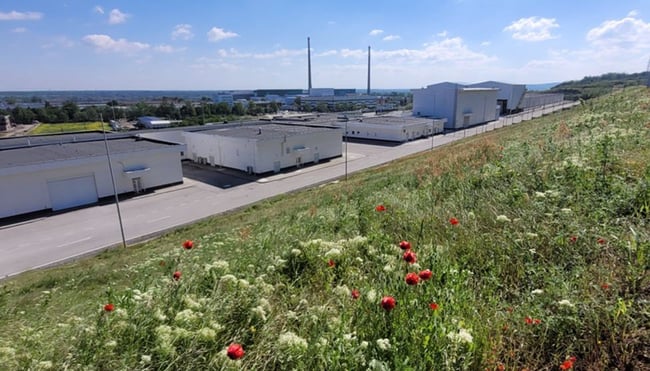

Bulgaria's new National Repository for Medium and Low Radioactive Waste is a massive facility that includes a liquid radioactive waste management system, substations, HVAC subsystems, fire and water supply systems, and all the other infrastructure systems to support it.
Because it was a first-of-its-kind facility, many subcontractors initially chose their own hardware and control methodologies because the original specification was not robust enough to provide functional automation information.
That's when TUVI stepped in to handle radiation monitoring. But as construction progressed, TUVI realized the radiation monitoring system was only one piece of a much larger challenge. The site was becoming a patchwork of control systems. Ultimately, a future-ready system would need to bring all of it together in a unified interface. So TUVI proposed a broader approach.
Whatever platform they chose would need to integrate with existing equipment from multiple vendors, adapt to changing field conditions, and scale as construction continued.
Read the complete case study to see what they built.
Visit our Case Study library for more application success stories featuring groov EPIC and groov RIO.
Do you have an application you'd like to share? Learn more about our Case Study Program and how it can help set you apart as an industry expert.