
Meet Opto 22's new technology partner SORBA.ai—helping manufacturers turn operational data into actionable predictions, decisions, and automated intelligence.
What if your industrial data could do more than tell you what’s happening—it could help predict what happens next?
SORBA.ai brings no-code industrial AI and machine learning to Opto 22 systems, helping teams detect anomalies, predict equipment behavior, optimize processes, and turn operational data into actionable intelligence.
Learn how SORBA.ai integrates with groov EPIC and groov RIO—and what problems it can help you solve.
SORBA.ai delivers a no-code Industrial AI and machine learning platform designed to help manufacturers and industrial organizations turn operational data into actionable predictions, optimized decisions, and automated professional intelligence.
The SORBA.ai platform enables operations, engineering, and automation teams to build and deploy machine learning solutions without requiring data science or programming expertise. Applications include anomaly detection, predictive maintenance, virtual sensors, forecasting, process optimization, computer vision, and closed-loop control.

Integration with Opto 22
SORBA.ai and Opto 22 combine industrial connectivity, edge control, and machine learning to create a practical architecture for bringing AI directly into industrial operations.
Opto 22 connects and controls the process. SORBA.ai learns, predicts, and optimizes it.
Opto 22 groov EPIC® and groov RIO® provide an industrial edge connection between plant-floor equipment and SORBA.ai. Real-time data from sensors, instrumentation, PLCs, machines, and other automation systems can be collected through the Opto 22 environment and made available to SORBA.ai using open industrial technologies such as MQTT with Sparkplug B, OPC UA, REST APIs, and Modbus TCP.
This creates a straightforward operational path.
Sensors & PLCs → groov EPIC/groov RIO → SORBA.ai → Prediction/Optimization → Operator or Control System
SORBA.ai applies no-code machine learning to this operational data to detect abnormal conditions, predict equipment and process behavior, create virtual sensors, forecast future conditions, and determine optimized operating targets.
The resulting predictions and optimized values can then be made available to the operational environment for visualization, alarming, operator decision support, historization, or, where appropriate, use within automation and control strategies.
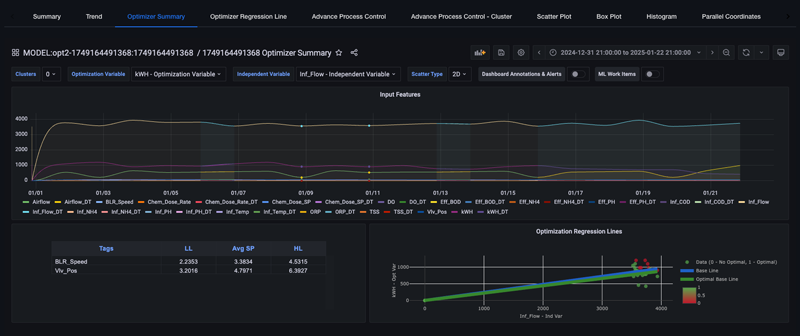
From machine monitoring to machine learning
SORBA.ai can continuously analyze process and equipment variables collected through the Opto 22 environment as a multivariable dataset rather than treating each tag as an independent alarm.
Instead of simply asking “Did this temperature exceed its limit?”, SORBA.ai can evaluate “Is the relationship between temperature, pressure, flow, equipment load, speed, and production rate behaving differently than it normally does?”
This multivariable approach can identify abnormal equipment and process behavior that may develop before conventional threshold-based monitoring detects a problem.
From prediction back to operations
The integration is not limited to moving operational data into an analytics platform. SORBA.ai model outputs can become operational variables in their own right. These outputs can include:
- Anomaly Score: An indication of how far current equipment or process behavior has deviated from learned normal operation.
- Predicted Process Value: A calculated future temperature, pressure, flow, quality, production, or other process condition.
- Virtual Sensor Value: A machine-learning estimate of a variable that is difficult, expensive, or slow to measure directly.
- Predicted Equipment Condition: An indication of developing equipment degradation or abnormal operation.
- Optimized Setpoint: A recommended operating target calculated to improve throughput, quality, energy consumption, reliability, or another operational objective.
- These values can be presented to operators, incorporated into dashboards and alarms, historized for analysis, or used as inputs to automation and control strategies.
Closing the loop
For appropriate applications, Opto 22 and SORBA.ai can extend the architecture from monitoring and prediction into process optimization.
The operational cycle becomes: COLLECT → LEARN → PREDICT → OPTIMIZE → ACT
Opto 22 — COLLECT & ACT
Connects to the physical process, acquires real-time operational data, and provides the automation layer for interacting with equipment.
SORBA.ai — LEARN, PREDICT & OPTIMIZE
Analyzes operational data using machine learning to identify abnormal behavior, predict future conditions, create virtual sensors, and determine optimized operating targets.
For example, groov EPIC may collect pressure, flow, temperature, valve position, pump speed, and energy consumption from a process. SORBA.ai can learn the relationships among those variables, predict future process behavior, and determine an operating target designed to reduce energy consumption while maintaining required production.
The resulting prediction or optimized target can then be made available to the operational environment for operator decision support or, where appropriate and subject to the customer's control logic, validation, and safeguards, incorporation into a closed-loop control strategy.
Because the architecture is built around open industrial standards, organizations can add industrial AI to existing automation environments without requiring replacement of the underlying control infrastructure.
Together, Opto 22 and SORBA.ai provide a pathway from connected equipment to predictive, optimized, and AI-assisted industrial operations.
What problems can it solve?
Predictive maintenance and reducing unplanned downtime
The problem: Traditional alarms and condition monitoring systems typically rely on predefined thresholds. Complex changes in the relationships among equipment and process variables can develop before those thresholds are crossed, leaving maintenance teams with limited warning of developing problems.
The solution: SORBA.ai applies machine learning to real-time and historical equipment data to learn normal operating behavior and identify anomalies, degradation patterns, and developing equipment conditions.
Using operational data collected through the Opto 22 environment, SORBA.ai can help identify potential problems earlier, allowing maintenance and operations teams to investigate developing conditions before they result in equipment failure, production loss, or unplanned downtime.
Connecting OT data to Industrial AI
The problem: Valuable industrial data is often distributed across PLCs, sensors, machines, databases, historians, and legacy equipment. Connecting this information to AI platforms can require significant engineering and custom integration.
The solution: Opto 22 provides standards-based connectivity at the industrial edge, while SORBA.ai provides the data ingestion, transformation, and machine learning capabilities needed to turn operational data into usable intelligence.
Together, they provide a flexible architecture for connecting existing industrial equipment to AI without requiring organizations to replace their existing automation infrastructure.
Building machine learning models without data scientists
The problem: Industrial organizations often have valuable process data and deep operational expertise but lack the specialized data science resources required to develop and maintain machine learning applications.
The solution: SORBA.ai provides a no-code environment for building industrial machine learning models. Engineers and subject-matter experts can select operational variables, train models, evaluate results, and deploy predictions without writing traditional machine-learning code.
This allows the people who understand the equipment and process to participate directly in developing and deploying industrial AI applications.
Creating virtual sensors and predictive measurements
The problem: Some important process variables are difficult, expensive, or impossible to measure continuously. Laboratory measurements, quality parameters, emissions, composition, and other variables may only become available after significant delays.
The solution: SORBA.ai uses regression and multivariable machine learning models to create virtual sensors that estimate difficult-to-measure variables using other available process signals.
Real-time information collected through the Opto 22 environment can serve as model inputs, enabling SORBA.ai to continuously calculate predicted values that can be made available to operators, applications, dashboards, historians, or control systems.
Process optimization and closed-loop control
The problem: Many industrial processes operate using fixed setpoints, operator experience, or manually tuned control strategies. As operating conditions change, these approaches can create opportunities to improve throughput, energy consumption, quality, and process stability.
The solution: SORBA.ai combines machine learning, digital twins, forecasting, and optimization technologies to evaluate process behavior and determine operating conditions designed to improve targeted outcomes.
Optimized recommendations can be presented to operators or, depending on the application, the control architecture, validation, and appropriate safeguards, incorporated into automated, closed-loop optimization strategies.
Opto 22 provides the industrial edge connectivity and automation layer between the physical process and SORBA.ai's prediction and optimization capabilities.
Improving quality and reducing process variability
The problem: Product quality is often influenced by many interacting process variables. Determining which conditions contribute to defects, scrap, rework, or inconsistent production can be difficult using conventional trending and reporting tools.
The solution: SORBA.ai analyzes relationships between process conditions and production outcomes to identify the variables and operating patterns that most strongly influence quality.
Models can then predict quality outcomes, identify abnormal production conditions, and help operators maintain processes closer to desired operating ranges.
Deploying AI while maintaining data sovereignty
The problem: Many industrial organizations want to use advanced AI and machine learning, but cannot send sensitive operational data outside the plant or enterprise network because of cybersecurity, regulatory, latency, or data-governance requirements.
The solution: SORBA.ai supports on-premise and edge deployment, allowing machine learning models and AI applications to operate within the customer's environment.
Combined with Opto 22's industrial edge architecture, organizations can collect, process, analyze, and act on operational data close to the source while maintaining control over where their industrial data resides.
Have questions or an application you'd like to discuss?
Talk to an Opto 22 engineer to get started, or visit the SORBA.ai website for more information.
And visit our Technology Partners page to see the complete list of partners, learn how their technologies fit with Opto 22 products, and see how you can benefit from these partnerships.